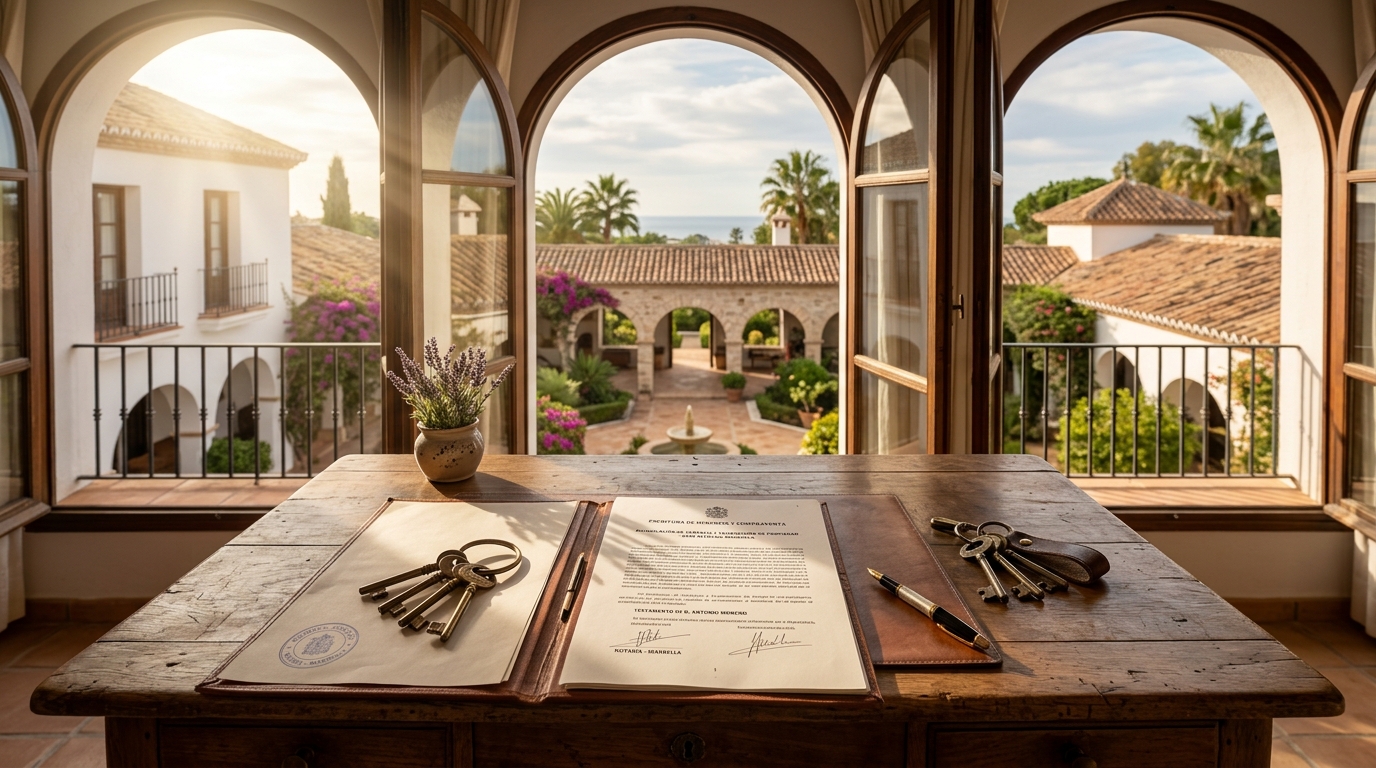
Estate Succession & Conveyancing · Spanish Civil Code
Inheriting a luxury property on the Costa del Sol and subsequently selling it involves a mandatory two-phase legal process under Spanish law: Phase 1: Formal Acceptance & Registration of Inheritance (*Aceptación y Adjudicación de Herencia*), followed by Phase 2: Sale & Conveyancing to an Incoming Purchaser (*Compraventa*). In Andalusia, non-resident direct heirs (spouses, children, parents) benefit from a 99% regional Inheritance Tax bonification, making succession duties virtually negligible. Furthermore, when structured properly, the declared inheritance valuation can minimize or entirely eliminate future Capital Gains Tax upon sale.
Inheritance & Sale Parameters (2026)
Navigating Cross-Border Succession & Property Disposal in Spain
Inheriting a residential property in Spain as a foreign national (whether resident in the UK, United States, Germany, Scandinavia, or beyond) often occurs during an emotionally challenging period. Foreign heirs frequently assume they can immediately place the property on the market and sign a sales deed. Under Spanish civil law, however, title does not automatically transfer to heirs upon probate in the deceased's home country.
To establish legal capacity to sell, foreign heirs must execute a formal public deed of acceptance of inheritance (*Escritura de Aceptación y Adjudicación de Herencia*) before a Spanish Notary Public, settle regional succession taxes with the Andalusian Tax Agency, and register their title at the Land Registry (*Registro de la Propiedad*).
This guide provides international executors and beneficiaries with an authoritative step-by-step roadmap to efficiently navigating Spanish inheritance procedures, optimizing tax liabilities, and successfully completing a property sale.
1. Stage 1: Mandatory Legal Documentation for Foreign Heirs
Prior to appearing before a Spanish Notary, your appointed conveyancing lawyer (*abogado colegiado*) must compile and legalize the following documentation:
1. International Death Certificate & Hague Apostille
EssentialThe official death certificate issued in the deceased’s home country must be legalized with the Hague Apostille (*Apostilla de La Haya*) and translated into Spanish by an official certified sworn translator (*Traductor Jurado*).
2. Certificate of Last Wills (*Certificado de Últimas Voluntades*)
Ministry of JusticeObtained from the Central Registry of Last Wills in Madrid, confirming whether the deceased executed a valid Spanish Will (*Testamento en España*). If a Spanish will exists, an authorized copy is retrieved from the archiving Notary. If only a foreign will exists, foreign Grant of Probate documents legalized with the Hague Apostille are utilized under EU Succession Regulation 650/2012.
3. Foreigner Identification Numbers (NIE) for All Heirs
Tax IdentificationEvery beneficiary inheriting property in Spain must obtain a personal **NIE (*Número de Identificación de Extranjero*)** from the Spanish National Police or via a Spanish Consulate abroad to settle inheritance taxes and register title deeds.
2. Stage 2: Settle Inheritance Tax (ISD) with 99% Regional Relief
Within 6 months of the date of death (extendable by an additional 6 months upon written application), heirs must submit regional Inheritance Tax returns (*Modelo 650*) to the Andalusian Tax Agency (*Agencia Tributaria de Andalucía*):
Group I & II Beneficiaries (Spouses & Children)
- • €1,000,000 Tax-Free Allowance: The first €1,000,000 of inherited value per direct beneficiary is 100% tax-exempt.
- • 99% Bonification on Excess: Any value exceeding €1M benefits from a 99% regional tax bonification, resulting in nominal succession tax liabilities.
Strategic Valuation for Future Capital Gains
When declaring the property value in the Inheritance Acceptance Deed, setting a realistic, current fair market value establishes a high acquisition cost baseline. Because inheritance tax is virtually 0% in Andalusia, this strategic valuation legally shields the heirs from future Capital Gains Tax (IRPF/IRNR) when selling the property.
3. Stage 3: Executing the Property Sale (*Compraventa*)
Once the inheritance deed is signed, the heirs proceed with marketing and selling the estate. To maximize efficiency, conveyancing lawyers routinely organize a simultaneous Notary completion:
Simultaneous Notary Signing
The heirs execute the Inheritance Acceptance Deed at 11:00 AM, and immediately execute the public deed of sale (*Escritura de Compraventa*) with the incoming buyer at 11:30 AM before the same Notary Public, eliminating intermediate registration waiting times.
Non-Resident 3% Tax Retention
When non-resident heirs sell Spanish real estate, the buyer is legally obligated to withhold 3.0% of the purchase price (*retención del 3%*) and remit it to the Tax Agency (AEAT) via Modelo 211 on account of potential seller capital gains tax.
4. Multi-Heir Sibling Buyouts: The *Extinción de Condominio* Tax Advantage
When multiple siblings inherit an undivided luxury villa (*proindiviso*) and one sibling wishes to keep the property while buying out the others, executing a standard purchase contract triggers standard 7% ITP. Spanish law provides a significantly cheaper legal mechanism:
Dissolution of Joint Ownership (*Extinción de Condominio*)
Rather than selling shares, the co-heirs execute a public Notary deed of dissolution of joint ownership. The sibling acquiring full title compensates the outgoing siblings in cash (*compensación en metálico*).
Capital Gains Exemption
Under Spanish Supreme Court jurisprudence, the dissolution of joint ownership at the declared inheritance value is not considered a taxable capital gain for the outgoing siblings, provided the cash compensation matches their exact fractional share of the original valuation.
5. International Probate Workflow: UK & US Grants of Probate
For foreign heirs managing probate from abroad without a Spanish Will, following the Hague Convention legalization workflow is mandatory:
6. Managing Spanish Bank Accounts & Estate Liquidity
Upon notification of a death, Spanish financial institutions are legally obligated by the Bank of Spain to temporarily freeze the deceased's bank accounts (*bloqueo preventivo de cuentas bancarias*). Understanding how to manage liquidity during this period is essential:
Permitted Automatic Debits
Even while frozen, Spanish banks continue to honor essential direct debit mandates (*domiciliaciones bancarias*), including municipal property taxes (IBI), utility bills (water, electricity), community of owners fees, and funeral expenses.
Releasing Estate Cash Funds
To unfreeze and disburse account balances to beneficiaries, the bank's legal department requires: 1) The registered Deed of Acceptance of Inheritance; 2) Proof of Inheritance Tax settlement (Modelo 650 stamped by the Andalusian Tax Agency); and 3) Heirs' valid NIE numbers and passports.
Inherited Property Advisory